Gimkit quizzes often overwhelm teachers with setup questions, especially when balancing engagement and time. The hard limit is 400 questions per kit, but optimal numbers vary by class. This guide delivers USA-focused strategies, backed by educator insights, to maximize learning without fatigue.
Direct Answer
Gimkit allows a maximum of 400 questions per kit, as confirmed by official forums and teacher experiences in US schools.
This cap prevents overload while supporting robust quizzes for live or homework modes.
Exceeding it blocks additions, forcing kit splits for larger topics.
| Use Case | Recommended Questions |
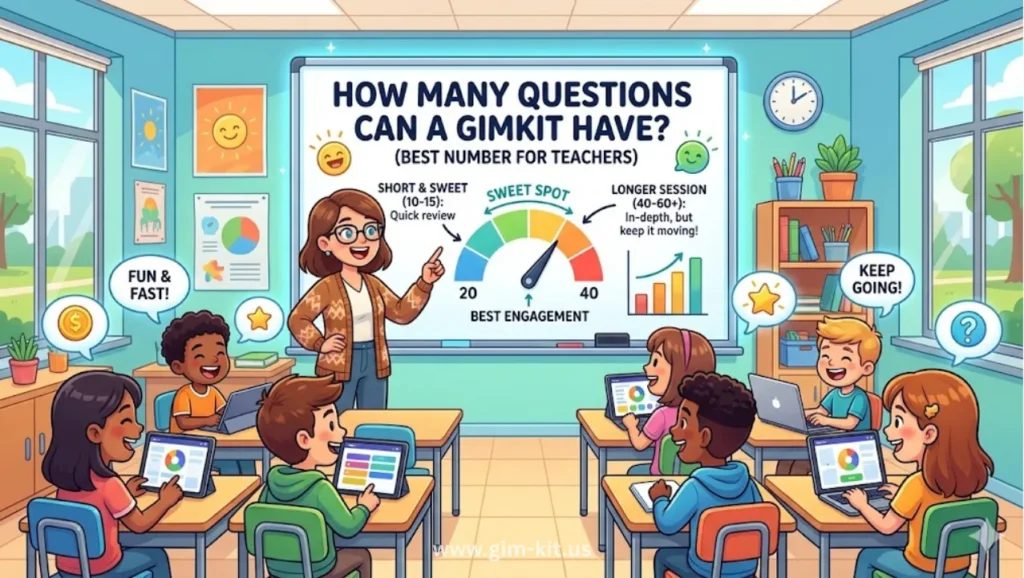
| 10 min class | 10–15 |
| 30 min class | 25–40 |
| 60 min class | 40–60 |
These ranges suit fast-paced USA K-12 sessions, ensuring full playthroughs without rushing.
Shorter kits fit quick reviews; longer ones enable strategic power-up use in modes like Classic or Zombies.
What Happens If You Add Too Many Questions?
Lag issues spike in large groups (30+ students), slowing devices on standard school Wi-Fi common in US districts.
Student fatigue sets in past 50-60 questions, dropping accuracy from 80% to under 60% per teacher reports.
Lower engagement follows as kids disengage, with energy modes exhausting too fast—e.g., 10K energy/question limits to 5-6 plays.
Best Number of Questions
Base on class duration: 10-15 for short bells (common in US elementary), scaling to 40-60 for high school blocks.
For age groups, use 20-30 for K-5 (short attention), 40+ for 6-12 (deeper retention via repeats).
USA teachers report 80 answers/student in 30-min sessions as ideal for retention without burnout.
Pro Tips
Repeat questions 2-3 times boosts mastery—analytics show accuracy jumps 20% on revisits.
Mix difficulty levels: 60% easy, 30% medium, 10% hard keeps pace; pair with audio/images for inclusivity.
Game modes impact playtime—Classic suits 40 questions, Zombies thrives on 50+ for energy farming.
Gimkit vs Kahoot vs Quizizz
| Feature | Gimkit | Kahoot | Quizizz |
| Question Limit | 400/kit | 500 max | Unlimited |
| Engagement Style | Earnings/power-ups | Live racing | Self-paced |
| USA Pricing | $9.99/mo Pro | $17/mo | Free/Pro $79/yr |
| Best For | Strategic 30-60 min | Quick 10-20 min | Homework |
| Lag Risk (Large Class) | Medium (400+ Q) | High (real-time) | Low |
How to Create Perfect Kit Fast
- Log in at gimkit.com; select “Create Kit” for USA-aligned templates.
- Use Question Bank—search public kits, add via “+” (e.g., 20 history questions in seconds).
- Shortcuts: Import Google Sheets/Quizlet; AI generates 10-20 questions/topic via Pro tools.
- Mix types (MC, open, audio); test in Preview mode.
- Assign to classes—auto-grades homework. Total: under 10 minutes for 40 questions.
FAQs
Can Gimkit handle 100 questions?
Yes, easily—up to 400, but cap at 60 for live USA classes to avoid lag.
What is the limit of Gimkit?
400 questions per kit; no total kit limit on Pro plans..
How to create your own questions on Gimkit?
Click “Add Question” in editor—type text, add images/audio, set points.
Can I create a Gimkit quiz?
Absolutely—free basic; Pro unlocks unlimited edits/power-ups.
How many questions can Gimkit generate with AI?
AI suggests 10-50 per topic in Pro; refine manually for accuracy.
Can I import questions from Gimkit?
Yes, via Question Bank—search/add from public kits instantly.
What is Gimkit?
Game-based quiz platform for USA classrooms; earn cash for power-ups during live/self-paced play.
How many questions can a Kahoot have?
Up to 500, but real-time lag hits at 100+ in big groups.
What are the different types of questions in Gimkit?
Multiple choice, open-ended, audio, image-based, draw—that.
Does more questions = better learning?
No—40-60 optimal; excess causes fatigue, per US teacher data.
Conclusion:
In summary, while Gimkit allows up to 400 questions per kit, the most effective quizzes usually contain 25 to 60 questions depending on class time and student age. By selecting appropriate question counts, mixing difficulty levels, and using smart setup tools, teachers can create interactive quizzes that boost retention, reduce fatigue, and keep students motivated throughout the lesson